Do I Have Binge Eating Disorder?
BED Binge Eating Disorder Treatment Miami

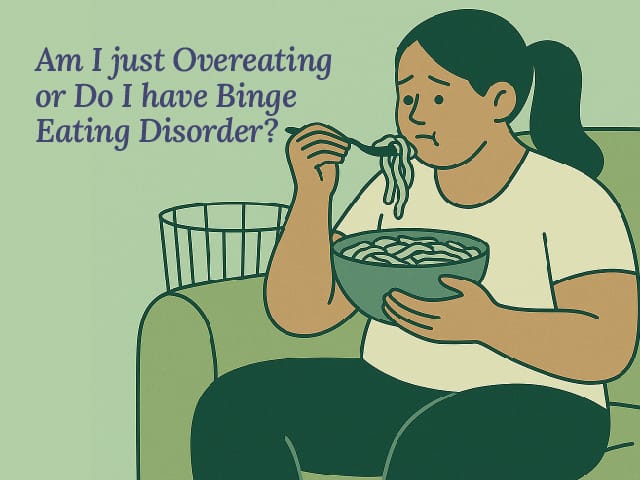
Am I just Overeating or Do I have Binge Eating Disorder? 

The other day, my family celebrated my niece’s 6 and a half birthday. I know what you’re thinking… “Half birthday? That’s not a thing.” I agree. But my family is always looking for an excuse to celebrate; an excuse to eat cake.

And ice cream. 

Homemade banana splits, to be specific. With three different kinds of ice cream. And three different kinds of sauces to top it all off with.

Needless to say, I ate too much. I zoomed right past the “pleasantly full” point and straight to the point of bloated and sick and reeling with regret.

Can you relate?

Here’s the thing… We all overeat sometimes. Especially when there’s cake involved. And we’ve all uttered those same words (usually via groan), “Whyyyyyyyy did I just eat so much?”

 It is precisely because of this, the commonality of this behavior, that it can be truly challenging to recognize when overeating goes from “normal” to problematic.

If you are reading this right now, you’ve likely heard of Binge Eating Disorder (BED) and perhaps even wondered if this is something you might be experiencing. 

But when exactly does overeating qualify as “bingeing?”

And when exactly does bingeing become a full blown “eating disorder?”

Most importantly… how do you know if YOU have BED (Binge Eating Disorder) ?

If you are asking these questions, you might be feeling confused, overwhelmed, and more than a little scared. 

These feelings are valid and we want you to know that you are NOT alone. 

BED known as Binge Eating Disorder is the most common eating disorder in the United States, more prevalent than three times the number of anorexia nervosa and bulimia nervosa cases combined. It affects people of all ages, races, backgrounds, genders, and body sizes. Nearly 3 million Americans struggle with BED, most of them in secrecy and isolation. 

So, how do you know if YOU are one of the millions experiencing BED? Let’s get into it…

 
BED Binge Eating Disorder Treatment Miami

BED  (Binge Eating Disorder) is more than just occasionally overeating.

It is overeating that is characterized by a few key elements:

  • Feeling out of control. During an episode of bingeing, one typically feels out of control around food, like they cannot stop eating whether or not they want to. Often, they eat very quickly, regardless of hunger level, and continue to eat past the point of feeling uncomfortably full. This sense of loss of control is more important than the actual amount of food consumed when it comes to knowing if you have BED. 
  • Feeling shame or guilt. People with BED often feel shame, embarrassment, guilt, regret, self-loathing, disgust, frustration, hopelessness, and other distressing emotions during and/or after a bingeing episode. They may blame themselves for not having enough willpower or self-control. These feelings are more than a passing, “that was a bad idea.” They are strong and persistent negative feelings directed at yourself. It can feel like being at war with yourself, your mind, or your body.
  • Hiding and secrecy. Because of the shame and guilt around bingeing, many people experiencing BED try to hide their symptoms. They may binge late at night while others are sleeping or in the car before coming home. They may try to hide the evidence, disposing of empty food wrappers in secret or rushing to the store to replace the foods they’ve eaten in the pantry before family members notice. People with BED may also stash food away in hidden places in preparation for a later bingeing episode. 
  • Repeated episodes. BED is a pattern of repeatedly bingeing over time. If you experience a bingeing episode at least once a week for over three months, you may be experiencing BED. About 2/3 of people with BED experience repeated bingeing episodes for a year or longer.
  • Emotional eating. Most people with BED eat for reasons other than hunger and many times these reasons stem from emotions such as stress, loneliness, sadness, or even boredom. Eating can serve as a way to numb emotions or avoid dealing with underlying problems. BED can often develop as a response to trauma, abuse, past food insecurity, or other environmental stressors.
  • Specific cravings or obsessive thoughts about food. People with BED might experience strong specific cravings for particular foods or obsessively think about specific foods before bingeing. These foods are often sweet, fatty, or salty snack foods and “giving in” to eating them can often trigger a full-out binge with these foods as well as others.
  • Other disordered eating behaviors. Some people with BED might also engage in some other disordered eating behaviors between episodes of bingeing such as obsessive calorie counting, rigid dieting, or obsessing over their weight or body shape/size. However, most people with BED do not routinely compensate for bingeing episodes by purging, excessively exercising, etc. If body image is also a struggle, this blog on body image and recovery may help.
  • Problems in day-to-day living. As with most eating disorders, untreated BED tends to worsen over time, causing more and more problems in one’s daily life. Obsessive thoughts, persistent negative feelings, and secretive behaviors may disrupt one’s ability to be present in other areas of one’s life, causing strain in relationships, affecting work or school performance, and harming overall mental health. Untreated BED may also lead to significant weight gain and impaired physical health.   
 
BED Binge Eating Disorder Treatment Miami

A person experiencing BED (Binge Eating Disorder) will likely relate to many (if not most) of the elements listed above. But it is important to remember that everyone is different and no two cases of disordered eating are the same. 

If you are concerned that YOU or A LOVED ONE may be suffering from BED (Binge Eating Disorder)  or similar disordered eating patterns, please reach out to us!

Our team of licensed therapists, dietitians, and lifestyle coaches are here to help you find freedom, health, and healing! Take our simple two-minute quiz here and schedule a consultation with Dr. Jen to see if FAB might be a good fit for you!.


Author

Back to Blog

©FAB Food & Body Program

Terms and Conditions